Showing posts with label conversations of a writer. Show all posts

Thursday, March 19, 2015

Are You Dealing With Bad Reviews?

I had started a comment on a blogger friend's article and decided to create an article instead because it had grown larger and more complex than what I believe is appropriate for a comment. Thank you, Auden, for inspiring this post.

I'll quote the original question which prompted this response: 


There's a ton of advice out there on how to deal with bad reviews. They like to say "dwell on the good reviews." What if you don't have any glowing reviews to off-set the negative/indifferent ones?

I've had my two short stories on Amazon since 2012 and one of them has exactly one review and the other a whopping five reviews. I can tell you this much. I didn't ask for reviews, but when I got them, I was pleased. I'm far from inspired by the numbers, but I'm flattered by and appreciate the favorable responses by those who appreciated my work. However, I've not written or produced much these days and that makes me sad.

On the contrary, though a bad review has to hurt, it's not a lost cause, because bad reviews are those things that prompt you to explore and improve! Especially if you're passionate about storytelling.

Here are some questions to ask yourself if you feel you're not getting the feedback you desire. Do you attend a lot of writing conferences? I know they can be expensive, but the advice and information you walk away with is so wonderful! Have you joined a writing critique group? In-person group sessions can help your writing out quite a bit. Don't shrink away from advice and constructive criticism. It's out there. 

I've joined both, the Tallahassee Writers Association and the Florida Writers Association. Both organizations have welcomed me in such ways I can't even explain. You need to be around people who are driven and wired the same way you are in order to learn the lessons and solutions of the trade. These folks are willing to be there for you because their struggles are the same. 

Lethal Injection, The Seed is 7 pages, received almost 400 downloads, and I have 5 reviews, 1 from a relative. The story has no action but is described as powerful. How does that happen? Writing classes, conferences, critiques, and encouragement helped my confidence in putting the story out there. It's the readers who will figure out if it works or if it doesn't. If it doesn't work, I agree, it would be helpful if readers would provide better feedback. Unfortunately, they are not required to give anything of value. It's other writers who will fill that void.

So how do we improve as writers and storytellers? Stephen King advises that we read, read, and read some more. However, how do you take the time to read if you're pumping out novel after novel? After all, Dean Koontz does it! He has an excuse. He's famous and people buy his books because it's branded already. Come on! He's Dean Koontz. 

If you don't have the time to read much, do like I do. Audio books! They are great because I pop them in on my way to work, and they start up again when I'm driving home. 

:)

Hope I've been helpful in some ways.


Smiley faceIf you enjoyed this article and would like to receive future articles in your inbox --- Subscribe to our free newsletter

Saturday, January 31, 2015

Pick a Word Blog Hop

This is a stream of consciousness exercise. Please join in the fun, or not. If you join, don't feel like you must edit your post if you can help yourself, but visit other participants by taking their links and leave comments!

My word is chopped.

I picked this word out of the air, maybe because I was watching that Food Network show. Kids were competing, like 9 year-olds, using KNIVES! What the hell. Can someone say liability? I just saw a kid cut herself in the chopped kitchen. Am I over-reacting? Why do I choose a word which needs hyphenating and why do I choose words I don’t like to spell…like hyphenating. Sucks. And why did I even picked the word chopped anyway?

What can you do with this word except describe something that gets divided in two or more things, smaller things, smaller meaning lesser. Lesser meaning not more, so if I want more of something, now I have less because I chose to use the chopped and get lesser. Unless of course I keep all parts and glue them back together. My logic sucks, but as promised I have to post this shit, cuss words and all. This is embarrassing and I should never have decided to do this assignment.

Can I get something positive from this word chopped besides this chubby cute kid who just missed an opportunity to win 10 thousand dollars? Oh, yes! It’s the dessert round, now that’s freaking positive as hell. I’m getting another beer and watching this. Kids making dessert has to be better than my writing about the word chopped.

This is my stream of consciousness writing assignment. Please don’t judge me!

Join this linked assignment by adding your own stream of consciousness  work. Pick a word,, any word. Then write your post and share it here. Deadline has not been set yet, but if you spam this blog, you might get chopped!!


Smiley faceIf you enjoyed this article and would like to receive future articles in your inbox --- Subscribe to our free newsletter

Saturday, January 24, 2015

3 Types of Unbeatable Settings

I know I’ve probably harped on this before and I’m sure there are novelists out there who have used these types of settings, but I’ll go a step further and explain to you why they work for me. Remember, I’m the reader here, so I should know, right?


Put an ordinary man in an extraordinary place. 

Think about this for a moment. An ordinary man works in a third world country providing humanitarian aide to the natives. It is his passion and all the children love him, the men respect him, and the women shy away because he exudes virility and a superior masculinity. You, as the novelist, do not have to work that hard to show anything more about this character.


If you had an ordinary man in a setting where everyone else were ordinary, you would have to transform this character into an extraordinary one in order to stand out, or else what’s the point of this character anyway, right? Sounds like too much work to me and it doesn’t feel authentic.


Take me somewhere for the first time.

I’ve read plenty of novels with settings on beaches, cattle ranches, grand estates, and beautiful islands. I’m sorry, did I put you to sleep there? Why must romance involve beautiful sunsets, roses, and champagne? If you put me on a beach, the dominant sound of waves will ruin it for me, even if we’re supposed to be on the shores of some Caribbean island, unless you have other things going on too!


I want to listen to classical Malhum while walking through the streets of Morocco and biting into a sliver of B’stilla. Put the traditional settings out of your mind. Take me somewhere I can experience for the first time, and if you want to get more into the details you can even share the savory and sweet tastes of your pastry by describing it to me! MmMmm.


Pick an event, any event!

A carnival, a national football game, a political campaign, a wedding. Why do these work? Because it’s easy to hear, smell, see, and touch almost everything imaginable and the writer doesn’t have to work as much. Every beach has water and sand, but a carnival has rides, games, funnel cake, and people walking around with stuffed animals larger than their kids.


If you never had a wedding, here’s your big opportunity. You can make it as extravagant as you like and not have to pay a dime. Everyone loves a wedding. I know it’s been done over and over again, but not by you, right?


Do you have favorite settings that draw you in EVERY. SINGLE. TIME?


Smiley faceIf you enjoyed this article and would like to receive future articles in your inbox --- Subscribe to our free newsletter

Tuesday, December 23, 2014

Cooking Inspiration for Writing Horror

I don't understand why it is that every time I'm cooking something, whether for myself or for others, I get this sudden urge to sit down and write. It's the complete opposite from when I actually sit down in front of the computer, where I'm expected to write, and nothing comes to fruition in my tiny noggin.

I need to get these things off my chest because they're disturbing, these things which come to mind while I'm cooking.


Mixing Eggs

I think the same thing every time I poke egg yolks in a bowl and start whisking away at them with a fork. Drowning eyeballs blink back at me and brains scatter about the bowl screaming, "Noooo, please....!" And you know those bubbles that form when you've whisked away fast and furious? They balloon up and pop like in a cauldron of some witch's brew.


Seriously, this is what I see.


It's even more fascinating when you dump the mixture into a skillet waiting with a thin layer of piping hot oil. The fizzing and hissing, along with the bubbling, inspire me to write something horrific. It's excitingly violent.


Rolling Dough

I like the yeast dough, that stuff you have to let sit a while so that it puffs up nice and airy. I never understood all that making it bigger and airy. Aren't you just smashing out all that air when you punch and roll the dough? Duh.


Can you imagine
how this might end up if dough could punch back?


I don't do a lot of baking. Much of this I witness on the Food Network. Every time I see this rolling of dough, I get a sudden urge to write about my last mammogram experience. The mammogram is no joke. Get one every year if you can. Just don't look up into the mirror while your boob is smashed down to an eighth of an inch between two Plexiglass plates. You'll never look at rolling dough the same.


Pancakes on a Griddle

Anyone else addicted to watching pancakes form on a griddle? It's like I can't take my eyes off the holes. I try to count them as they appear. Things get overwhelming when they multiply exponentially, so I watch the batter dry instead. I find myself wanting to write about craters forming on the moon's surface and folks trying to escape while molten lava fills in on all sides until the tiny people are forced to jump into pits filling with fiery rage.


Looks like a flattened moon, doesn't it?


Then it's time to flip the pancake and the batter splats out the sides, just like I imagine a batch of lava spilling onto a flat surface. I should try red velvet pancakes next time.


Hot Dogs in a Microwave Oven

They always split at the tips, kind of like how a flower blooms, or a screaming alien. From the middle of each tip, the very first second, there go the ends. Boink. And they're steaming hot after 3 seconds. For some reason the middle of the dogs stay warm. I thought the microwave cooks from the inside out?


Painful, right? The creators of Alien
could have saved a lot of money using this image.


Hot dogs cooking in a microwave is the only activity which makes me think of human flesh and how it might blister and split when baked too long in the Florida sun. Skin cancer is no joke either. Stay out of the sun as much as you can, wear sun screen, and see your dermatologist annually.


Hamburgers on a Grill

A hamburger is supposed to be grilled on high heat. When done right, it gets that pink, bumpy texture everywhere and the bumps are surrounded by bloody streams   and this white solidifying  juice around the perimeter of the patty - always looks like a large canker sore to me. I know gross, right?


You're lying to yourself...
if you don't think this looks like some sort of STD.


****

So why does cooking reflect this imagery? Leave your thoughts in the comments below.


Smiley faceIf you enjoyed this article and would like to receive future articles in your inbox --- Subscribe to our free newsletter

Saturday, November 15, 2014

The 5 Office Villains

When I think about the villains I'd like to develop, I imagine those people I've known in the past who annoyed the hell out of me. Is it a great way to get sued? I don't think so, because these folks are everywhere, and it's kind of hard to pinpoint oneself when you aren't even aware that you have these annoying qualities.

My favorite villains are those driven by insecurities rather than the goals and objectives they set, unlike evil lords and emperors, who basically have no weaknesses. Those archetypes either want to destroy the world or own it. That's boring. It's more fun to watch the amateurs! :)


The Identity Thief

This is the person who wants to be you. They love everything about you, but won't admit it. They want your money, your looks, and your brains. Why? How the hell else are they going to be like you without stealing your identity? It's not like they can work for it themselves, lazy bums.


At the end of my story, this person would unknowingly steal the identity of a convicted child molester who violated probation for failure to register as a known sex offender. That'll teach them. =)


The Ignorant Narc

She's in everyone's business and thinks nobody knows she secretly envies everyone who has anything she doesn't, which is basically a lot to make up for. She has nothing going on in her life, so she reports on everything going on in your life, in your friend's life, in your dog's life, and essentially anything else she can make up. Little does she know, the person to whom she's reporting these things also thinks she's a loser.


It's hard not to feel sorry for this character, so in order to avoid making her a sympathetic character, she cannot EVER feel loneliness or self-pity. Keep the evil intact and do not give her any redeeming qualities.


The Immoral Whore

You know this person as the one who is sleeping with the boss to get ahead. He thinks everything is discreet as he slips into the big cheese's office to get a little quickie. He comes out adjusting his tie and gives his colleagues a little wink before heading back to his office.


He takes long lunches with the boss, they wait on each other before heading over to the "big" morning meeting, and they laugh and joke, coffee in hand, on the way back from the "big" meeting. He eventually gets fired for under performance, but we saw that coming, didn't we?


The Dastardly Moron

This one likes to be the smart guy who knows everything about anything, but nobody's allowed to actually SEE any of this knowledge in any sort of product he has created. You only get to hear him talk about his prowess, but you never see the results of anything he's ever accomplished.


Don't disturb him, either. He's BUSY! The boss is convinced this guy is a genius and now our superstar is trying to figure things out, all on his own, before he's found to be an utter moron. All the while he's screwing up all those things you will eventually have to fix once he's fired.


The Yes Man

Tim says I must absolutely list the "Yes" man. But I'll stop picking on the guys so much, so this next one will have to be the "Yes" woman. You know her as that person who agrees wholeheartedly with the new boss every chance she gets, no matter the utter moronic decisions executed.


The new boss says, "I think [Dastardly Moron] is doing an outstanding job. I think I want to promote him to management."

[Yes Woman] says, "Oh I AGREE with you! [Dastardly Moron] would make an excellent addition to the management team. Great call, boss! When I first met you, I just knew you would take charge and come in and get shit done around here. Are those new shoes? Those look like a pair I have at home. I do admire your taste."

Now, get back to work. But, share this first. We need to spread the word about this untapped resource of readily available villains.

Which of these would you vote as most annoying?


Smiley faceIf you enjoyed this article and would like to receive future articles in your inbox --- Subscribe to our free newsletter
Wednesday, October 29, 2014

Finding Your Writing Niche

I don't know why I did it, but today I purchased William Zinsser's On Writing Well from a gift shop bookstore. It was a little pricey, but the impulse, arising from boredom, put me in a curious mood. The front cover of this book clearly warns it is a "Classic Guide to Writing Nonfiction."


Did you see that? The color of the operative word is red.

I've been trying to produce a fictional novel for the past several years. I've written fourteen chapters in my third attempt. Why would I gravitate toward such an extreme as nonfiction? I had to ask myself this because my appetite for fiction seems to have taken a dive. I leave my manuscript at various stages and in multiple locations: Dropbox folder, flash drive, external hard drive, etc. Sometimes I wonder when I'll actually hunker down and go looking for the most current version. Sad?!

So now I ask myself. What "nonfiction" subject would appeal to me? I've pampered my blog for 5 years now and I've never once treated it like I do my manuscripts. I haven't ignored it for months at a time. I check the health of my blog with Google Analytics to ensure she's getting the proper attention. I post articles with keywords resulting in promised and predictable results. So why don't I allot the same attention to my manuscript?

After I read the first 3 chapters of Zinsser's book, a revelation struck me. I'm not a storyteller. I don't have a story I can jot down in a set number of words to make a novel. I'm a writer who wants to tell you about what I know and believe. That's why I return here so much. I'm not wired to tell stories. I'm wired to give an opinion about things I care about, namely writing and the crap that happens to me.

This is sort of about writing, but it's more about crap that happens to me. It's about the purchase of a writing book which may have changed my writer path. Whether that's for the better or not, we shall see.

Maybe I should look into memoir writing...

Topics available:

1. The Magic Closet - the story of my son who has A.D.D. and the number of times I found naked girls in his bedroom closet.

2. Hi, I Don't Belong Here - my week long stay in the hospital because I lost it, really lost it.

3. I'm Glad I Wasn't Aborted, Too - a candid discussion with my mother who revealed the fact she couldn't afford to abort me and the relief she felt afterward.

Trust me, all three are nonfiction titles! Please vote and let me know which story I should tell. I appreciate your input. You all have been with me through the years. You SHOULD be the ones I listen to when making these major decisions with my writing journey. I trust you. Write your votes in the comments below.


Smiley faceIf you enjoyed this article and would like to receive future articles in your inbox --- Subscribe to our free newsletter

Monday, October 20, 2014

Top Ten Replaceable Words

An article jumped out at me while at work today. A link to it in our weekly newsletter lured me away, the title being "18 Common Words You Should Replace in Your Writing." So what do you think I did while reading this article? I mulled over each word and instinctively produced some fresh ideas of my own, not just replacement words. I'll summarize 10 of the suggestions given, then provide my own thoughts.

1. Good - superb, outstanding, or exceptional.

I agree with this one. If you want to say something was good or someone did well, try a little creative back story.

I hadn't had a meal like that since grandma made her chicken and dumplings and won first place at the Greenwich Country Cook Off.

2. New - latest or recent

If you're talking about a recent batch of donuts, wouldn't they be warm and sticky? Choose words which describe the properties of being new or recent. Maybe the smell of alcohol-based duplicating liquid would indicate the recent production of examination papers a teacher passes along in class.

Jackie lifted the paper and sniffed at the drying fumes on the exam sheet Miss Robinson placed on her desk.

Okay, so if you were born circa 1980, you won't get this. Just carry on.


3. Long - extended, lingering, or endless

If you tell me that it's been a long time since you last saw me, isn't that subjective? Maybe I didn't want to see you again, in which case it hadn't been long enough. Instead, be specific.

"Oh my goodness! It's been 10 years since I last saw you."  
"That many years, huh? Seems like yesterday to me."

4. Old - ancient, fossilized, decaying, or decrepit

The frayed laces and the unglued, rubber-tipped soles of his tennis shoes are a better way to describe something in a specific manner. Again, old is subjective here. To someone who grew up poor, that's just the half way point.


5. Right - exact, precise, or correct

It is the right thing to do! Oh yeah? Whose moral code are you following anyway?

She is right. Really? You mean what she said is based on fact? She spoke the truth, or otherwise didn't tell a lie.

I enjoy my coffee with 2 teaspoons of sugar in an 8 oz serving. Just right, for me.


6. Different - odd, uncommon, exotic, or striking

Instead of using the word different, I like to read descriptions which show contrast.

He flung the fair-skinned maiden onto the center stage in a room filled with Arabic bidders eager to make the purchase for her endowments. They yammered in quick, high pitched syllables, and the whites of their eyes bulged wildly from their sockets.

We can assume the lady is different in many ways, including race, community status, emotional state. So, when describing differences, think about why something or someone is different or odd. Let the reader enjoy the difference.


7. Small - microscopic, miniature, or tiny

Another subjective adjective. Babies are small, but baby rabbits are smaller. Here is another opportunity to show with contrast. What if you read about a tall man who had stubby, two-inch fingers and one-inch thumbs. Weird, huh?


8. Large - substantial, immense, enormous, or massive

I agree, large is boring. Huge is better! I like the word ginormous, shared by a fellow geek at an IBM conference once.

If you tell me a man palmed a regulation sized basketball, I will assume he has large hands. When describing mountains, it is not necessary to refer to them as massive. For real, is there a mountain out there which isn't massive?

The reception bill for my daughter's wedding would be considered large or substantial, but mentioning that it totalled $21,000.00 puts it in perspective a bit, doesn't it? Details are more substantive than mere adjectives.


9. Young - naive, youthful, or budding

Please be reminded that old people can be naive too. As a matter of fact, schemers tend to target elderly folk who are more naive in the ways of social engineering through technology and digital media.


10. Almost - nearly, practically, or verging on

Why even use these at all? I think this robs us of the fun in having things actually happen. So what if someone nearly fell off a chair? Wouldn't it be funnier if they fell off the chair?


Do you have any replaceable words to add to the list? 

Smiley faceIf you enjoyed this article and would like to receive future articles in your inbox --- Subscribe to our free newsletter

Thursday, August 21, 2014

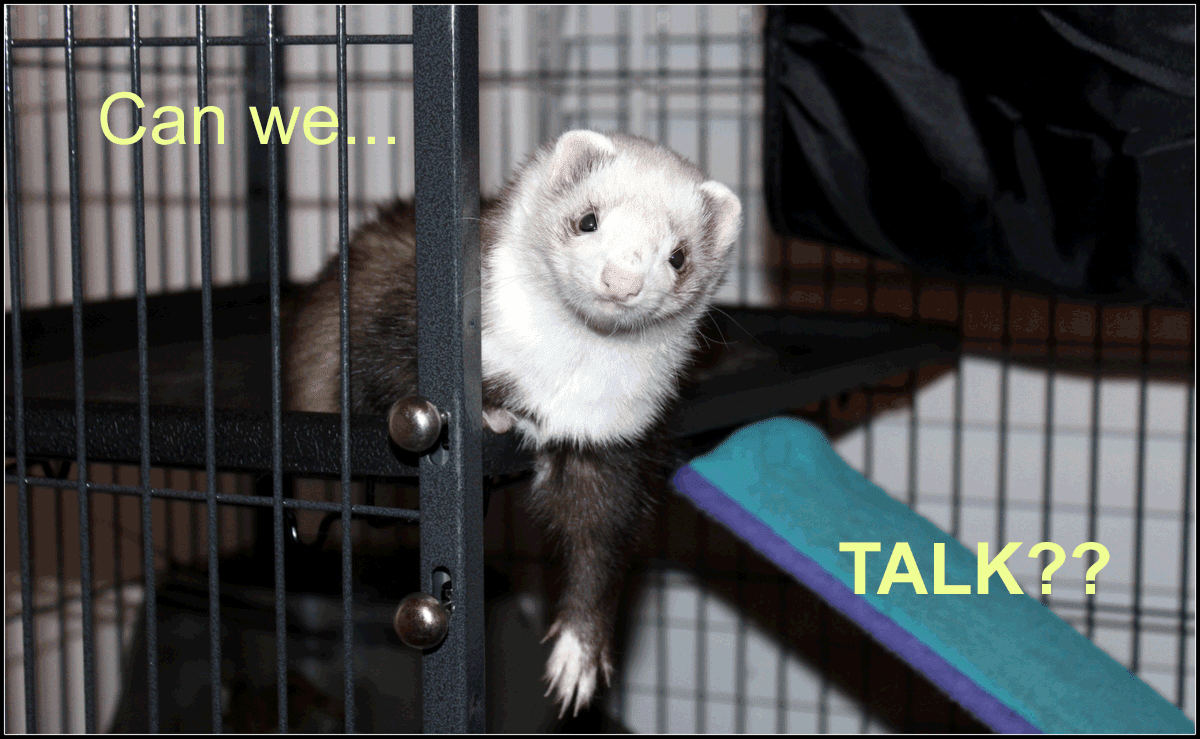
Battling Constructive Criticism - Ferret Style


Scholarly ferret has answers.
There are many things we'll hear from critique partners during our writing journeys. I've heard them about my stories and you'll hear them about yours, if you haven't already. These words are hurtful when you first hear them. After all, writing fiction is an art form and the creative soul cannot be judged, for art has value only to the artist. But if you want to sell your art, you are opening yourself up to scrutiny, right?

I encountered such criticisms in one of my first creative writing classes and I can tell you my reaction wasn't pretty. I'd spent almost $400.00 to take this class and I had better not hear anything but how great my writing is and how wonderful my story.

That didn't happen, unfortunately. I heard many things, and I'm about to share them with you. Trust me, I was steaming mad. The vulgar gestures I produced after having read the "constructive criticisms" of my classmates, went largely unnoticed, mainly because it was an online class and my computer shielded me from the rest of the group.


Q: Whose story is this?

A: What the hell are you talking about? It's my story, bitch!

Just kidding. When I was first asked this question, I wasn't sure what folks were talking about. I've introduced three characters already, so obviously it's about "at least" three characters, right?  ...right?


Confused ferret asks question.


It's their way of saying that they believe a story should have one main character and that character should have a story all about them and their journey. Fine and dandy! I get it. For new writers, maybe it's smart to stick to this "template" but seriously, there's more than one way to write a story folks.


Q: What is the main goal of your character?

A: Shouldn't you read more than the first chapter before you ask that question?

This is no joke. Why do you have to know the goal of my character when you start reading the story? Do you want to know the goal in the first chapter so you can then decide whether or not to buy the book? Is more than 15 minutes of reading in Barnes & Noble too much time to waste deciding whether or not the goal of my character is important enough to fork out $5.99? Read the back cover!


Angry ferret's favorite acronym RTFM


Okay, so the goal of my character is to travel to China, unlock the mystery behind the ancient Chinese secret, and rescue the world. Tada! End of story in only one chapter. Chapter Two: Does the Character Meet Her Goal?


Q: Do you expect us to believe your character actually drove off that cliff and survived?

A: It's fiction! 

The answer to this question is obvious. No, I don't expect you to believe it because it didn't happen for real. It happened in my story, and my story is fiction. If you do the same things my characters do and think you'll get away with it, then you deserve to die! Much like the Mountain Man.


Ferret wants you to chill.


Q: Couldn't you change it to read more like "blah blah blah blah blah, "blah, blah blah. Blah blah blah blah blah blah blah?"

A: No, because then it would be YOUR story, not mine.

Writers are so funny when we critique other work. We all do it, but let's be honest. When we like something, we always want a crack at it to see if our version will sound better, look better, smell better, or taste better. Just like chefs, there's always a twist to make it better. Just remember, it's my food you are sampling. If you like it, get the basic recipe. You can always add your twist to it in your own kitchen, when you make your version.


Ninja ferret is not happy!


Q: Why is there so much head-hopping going on here?

A: What the hell is head-hopping?

I seriously did not understand this whole concept of head-hopping. It made me angry for so many people to tell me I was doing this when I didn't even know what it meant. In the voice of a whiny, little brat, "How does Jane know that John is feeling sad? She's not privy to his thoughts."


Can you guess ferret thoughts?


Um, I'm the author writing the story. Jane doesn't need to know that John is sad. I'm telling you he's sad! I know he's sad and because I know he's sad, Jane knows he's sad, and now so do you! Now shut up and read the rest of my story.


Do you recall any criticisms which made you feel immediately defensive about your writing? Please share!


Smiley faceIf you enjoyed this article and would like to receive future articles in your inbox --- Subscribe to our free newsletter

Sunday, June 22, 2014

My Faux Pas While Conducting Research

I'm having an opportunity to review a thriller for a literary magazine and I so want to do a great job, an honest write up. So, what does an avid reader and fan of literary fiction do? We research anything that seems out of place. I think that's what we do.

It's my first official write up, so I wasn't quite sure what to do when I ran across a paragraph that simply did not ring true to me. I just couldn't believe that there would be 50,000 graves in a particular cemetery. Hell, Arlington National Cemetery has 300,000 (yes, I discovered this in my research) and they are the largest cemetery in the United States. Any other cemetery should pale in comparison, right?


So, what did you do, Diane?

I found the cemetery in question on the Internet and I called them!

"This is Lynn speaking, how may I help you?"

"Hi, Lynn. I'm conducting some research and would like to know how many marked graves you all have in your cemetery."

*silence*

*uncomfortable pause*

"I will find someone who can help you with that. One moment please."

Great customer service skills, by the way.

"Hello, Brett here. How can I help you?"

"Yes, I'm researching some information and would like to know how many graves you all have in your cemetery."

"Well ma'am, we have approximately 38,000 folks who have been laid to rest here and within various structures throughout our grounds and facility."

Now the silence was a massive white noise in my frontal lobe, slowly replaced with the knowledge of my faux pas. In my haste to uncover what I felt to be a greatly exaggerated metric, yet a highly insignificant piece of data conveyed in a work of fiction, I'd let my better judgement go and I had approached my target as if I were some insensitive ass. This isn't me, I promise.


So, what did it matter this number? Why did that red flag go up and why did I feel a compulsion to find out if it was true? If you say it was my OCD, that's partially it. It wasn't until I pondered my inner soul that I figured out what actually triggered that need to pull out of the story and go looking for answers.

Truth be told, I would never have questioned this had it not been a well-rounded, convenient number. If it was 46,000, fine! Even 51,000 would not have phased me a bit. I would have continued on with the story without even a single bump. Now I understand auditors a little more.

So there you have it. Stay away from well-rounded numbers, even if you've done your research. It will save your readers some embarrassment, maybe. Not every reader would think to call a cemetery and ask such a thing. Or would they?

Last thing I would like to do is publicly apologize for 1. Questioning the author's integrity (after all, it is fiction) and 2. Being such an insensitive ass toward all the 38,000 folks laid to rest in that cemetery. In closing, I think I've learned a little something about social etiquette.

Question of the day: What was the oddest research you ever conducted and what was the response?


Smiley faceIf you enjoyed this article and would like to receive future articles in your inbox --- Subscribe to our free newsletter

Tuesday, May 6, 2014

5 Motives For Animals in Fiction

I asked Tim to recall all the fictional novels he's read (or movies watched) where animals played a part. I did this because I was curious to know what other readers would come up with, not just me. He named the novels (movies) and I noticed there were, to me, different motivations for animals appearing as characters, even the walk-ons. These are the ones I found.


Please Like My Protagonist

At most conferences I've attended and online writing classes I've taken, the speakers have discussed this thing referred to as "pet the dog" which simply means get the reader to instantly like your protagonist. Whenever any character shows affection toward an animal, it will create this connection with your reader. How about an Orangutan? Remember Clyde in Every Which Way But Loose and its sequel? Best sidekick EVER!


Here's a quick example. When a cop picks up that cute puppy in an alley while searching for some bad guy, notice he gives it a quick snuggle before tucking it safely behind some dumpster? Now, back to the bad guy and doing the much needed deed, moving the plot along. It's not realistic, but it works. The cop has a soft spot, even while in the middle of a very dangerous chase. This cute scenario doesn't really belong in the story, but it serves one of two purposes for supplying elements which seem out of place. It adds to character development. The other would be to further the plot, which it does not.


Creating Conflicting Emotions

Two elements I love to experience at the same time are feeling my love for humanity and feeling love for a helpless NON-human type. How does one promote love for humanity? Um, you have an horrific animal which causes incomprehensible damage to society. Think King Kong, Godzilla, Food of the Gods, and Jaws. It's man against this indestructible creature wreaking havoc upon their villages.

And don't give these creatures any qualities that make them human, like King Kong actually falling in love with the girl. NOooooooo!!!! Now we have to like the creature, and that defeats the purpose of bringing society together to kill it. Talk about conflicting emotions for your readers.

In Jaws, the mother was protecting her 15 foot baby the fishermen killed! Those bastards. Of course, any mother would go after them murderers, and with great vengeance. How do you hate such a creature?


Creating Horror and Anticipation

One of the things in fiction that has a remarkable affect on readers, and I say this from my own experience as an avid reader of horror, is the mention of acts performed by domestic animals, acts we cannot deny but we cringe knowing of them. Like the cannibalism of hamsters when one of their own becomes ill. No, our pets are not cannibals!

Authors remind us of the horrors we wish to deny. They torture us with these tidbits of information, reminding our kindred of the evil which exists in our innocent world, the one we so desperately seek to escape. MWAHAHAHAHA!!

A stray dog wouldn't eat the scalp off a dead man. But, what if he'd been abandoned and was hungry, like the one in Stephen King's Gerald's Game? I think King described it like the sound of pulling up carpet? I don't care how hungry my Maggie ever gets, she'd never eat my scalp!


Promoting Religious Views

So, what does it say to you, the reader, when you read about the family pet who died? Pet Sematary is an example. Karma? Did you get a sense that the author had a particular religion they were depicting or did it just seem creepy to you? Coming back to life: evil times 3! I'm not suggesting this was the intent, but when I read the book, I felt a lot of ceremony in it.


Political Dissidence

Animal Farm is a great example of this, but that's literary stuff, so who cares? :)  Read it!

I use animals in my short story Snow Leopard. The cats in my story are major characters and they play a very prominent role in how I feel about political dissidence in America today. They are tools and my intent has always been the hope that my readers will relate on a deeper level at some point.


Okay, I admit, I'm being overly harsh on the writers out there, but I want to know. Do you think about why you include animals in your scenarios? Do you ever wonder why you find the need to include them? I think it's okay to do it, I just wonder if you know why you do it and do these specific reasons I point out hit the mark?


Smiley faceIf you enjoyed this article and would like to receive future articles in your inbox --- Subscribe to our free newsletter

Sunday, April 20, 2014

The Immersion Excursion

Have you ever picked up a book and read it from front to back in one sitting? Those are the books you discover by surprise.

Maybe you've experienced a story written by an author you'd never heard of, or one who created a one hit wonder and never wrote another word. How sad. I've read a few myself and now I ponder what glued me to my seat long enough to read an entire story without a break, not even for a bite to eat.


Dialogue

One common element shared by the quick reads I've discovered are the dialogue sequences. They're not thrown together simply to provide white space, making the pages less daunting. I recall meaningful dialogue, the kind which delivers progress in character development and plot.

And remember, the importance of dialogue is as much about what is said as it is about what is not said.


Setting

The setting is another element which completely immerses me into a story. It must be vividly clear to me where I am while experiencing the story. Recall Middle-earth in Lord of the Rings, Hogwarts in the Harry Potter series, and the land of Oz in The Wizard of Oz. All unique worlds, very distinct and memorable.

Don't be afraid to share your world. It makes the difference in the reader feeling welcome. When a visitor comes to your house, do you give them a tour or do you confine them to one room?


The 8 senses

When I was in high school, there were only 5 senses we were taught in health education and those were: sight, sound, touch, smell, and taste. Today, we include the senses of time, space, and the unknown. I give examples of each in a post I shared back in 2011.

When you use this technique, I am so focused and entertained, I have no interest in being tantalized in the real world with seeing, tasting, smelling, or anything else. It's like magic to me because the words show me what I already know, therefore, I'm relating on a whole different level, entranced!


Detail in Descriptions

When I read something familiarly exquisite, I stick around. That means I feel comforted when I encounter the details of an item in a story such as a Sesame Seed Biscotti or French Vanilla flavored coffee. Don't be lazy. Share the details. 

The added details give me a sense that I belong where I am; therefore, I have no interest in moving away from the story. I'll keep going because the comfort level is more enticing than putting down the book to go and find something general and bland which I hadn't thought of just yet. 

I further share Dialogue, Detail, and Description in an earlier post.


Voice

This is an element I don't read about often, but I know what it is and what it does for me. Voice is something that is important when you read a lot of books. It will save time for the reader when they finally discover the one voice which speaks to them like Vincent Price reading "The Raven" by Edgar Allan Poe. The way he dramatizes the reciting of the poem could be likened to an author's use of words and choice of cadence in the structure of their sentences.


It's difficult to immerse myself to this length these days because I work full time. But, I remember the days of middle school summer when I blazed through tons of Harlequin romances and wondered where the time had gone. I miss those days. I could immerse myself into another world, and these were the very elements which invited me to stay.


So, what keeps you on the page and turning until the very end?


Smiley faceIf you enjoyed this article and would like to receive future articles in your inbox --- Subscribe to our free newsletter

Sunday, April 13, 2014

When a Writer Questions an Artist

What happens when a writer questions the written words of a truly talented artist? Something completely unexpected and rather embarrassing is the answer.

One thing I would never do is question a literary icon about intent when it comes to his creations. If you don't understand allegories or metaphors, you have no business correcting someone about their artistic work on a technical level. My new hero is Don Henley (Eagles), for his answer to John Soeder in 2009 while being interviewed for The Plain Dealer. This man dared to correct an artist's choice of words.

The interview question?

On "Hotel California," you sing: "So I called up the captain / 'Please bring me my wine' / He said, 'We haven't had that spirit here since 1969.'" I realize I'm probably not the first to bring this to your attention, but wine isn't a spirit. Wine is fermented; spirits are distilled. Do you regret that lyric?

Assuming by "spirit" Henley must be referencing the wine in his written words, Soeder belittles the artist with his obnoxious question about regrets.

I love Henley's response:

Thanks for the tutorial and, no, you're not the first to bring this to my attention—and you're not the first to completely misinterpret the lyric and miss the metaphor. Believe me, I've consumed enough alcoholic beverages in my time to know how they are made and what the proper nomenclature is. But that line in the song has little or nothing to do with alcoholic beverages. It's a sociopolitical statement. My only regret would be having to explain it in detail to you, which would defeat the purpose of using literary devices in songwriting and lower the discussion to some silly and irrelevant argument about chemical processes.[1]

SuuuuLAM!!

This must have been a memorable moment for Mr. Soeder as he mentioned it while announcing his retirement back in 2012.

Don Henley and I locked horns, too, because I had the nerve to ask him about the wine-spirit confusion in the Eagles hit "Hotel California"; you can read all about it on Wikipedia.[2]

I'm making a correction here. You didn't "lock horns" with Henley, Mr. Soeder. What happened was something of the nature "he ate your lunch."

Let this be a lesson to the critics out there. Don't always assume your corrections mean anything to the Poet/Songwriter/Artist. We all love music, but if you want music to love you back, treat it with the respect it deserves.


1. Soeder, John. "Don Henley gets into the spirit talking about 'Hotel California'" The Plain Dealer March 20, 2009: T14

2. http://www.cleveland.com/pdq/index.ssf/2012/09/pop_music_critic_john_soeder_s.html


Smiley faceIf you enjoyed this article and would like to receive future articles in your inbox --- Subscribe to our free newsletter

Tuesday, December 31, 2013

Genre VS Literary Fiction - What's the Difference?

I was asked this question the other day and after thinking about my college years, learning about Ethnic Literature as well as American Literature, I pondered these differences. What I wrote then and what I read now (mostly horror and mystery) are quite different, but not by much. I've read a few debates about genre vs. literary fiction, and I discovered that so many authors get up in arms about their beloved writing, no matter with which group they relate.

Writers love what they produce on the page, like any artist to a canvas. So, it shouldn't be surprising that we defend our artistic pieces. So many critique our styles, our motivations, and our elitist attitudes. That's right, I just called us a bunch of elitists. I state this in a self-deprecating sense though, just to get it out there, in case you're already thinking of me as a literary snob. Yes, I'll admit, I love literary fiction, and I'm happy to share my favorite excerpts.

So, what IS the difference?


Lovers of literary fiction fall deeply with the idea of the work and the internal growth within the characters. They love the experience of reading the work, its beauty and simplicity. The introspection with which the story demands is the most compelling element of literary fiction, aside from its eloquently, flowing cadence.

I cried when I read David Copperfield by Charles Dickens. Why? Because the growth of David, the boy, into David, the man, was a phenomenal read and it touched me. I don't know how else to explain it.

Success, in the eye of the literary author, is experienced by the accumulation of acclaim by other literary types. The motivation is not for monetary gain, but rather the acknowledgement of the beauty within their intellectually stimulating prose.


Lovers of genre fiction enjoy a quick read with twists and plot. They are entertained by conflict and the elements of surprise, which pave the paths of their heros and heroines. Their experience is like a ride in a theme park. The masses love a good mystery or a great horror story. Many even love the romance, paranormal included.


Genre fiction is in high demand and so the number of copies sold and landing on the Best Seller list are indications of success for the genre fiction author, and thus monetary gain being the motivation behind writing. I'm not saying genre authors are not eloquent or compelling, and that they don't love to write, but simply their motivations are different due to a vast audience.

OH EM GHEE, did I just generalize? Yes, I think I did.

Am I adding to the stereotypes of literary snobs and genre rock stars? I hope not. This post was written in order to objectively compare and contrast, briefly, these two fiction types. I couldn't be more broad. Or could I?

Did I leave anything out? Should I have mentioned more about one group or the other?


Smiley faceIf you enjoyed this article and would like to receive future articles in your inbox --- Subscribe to our free newsletter

Thursday, November 21, 2013

Racist Intent or Desensitized?

A fellow blogger at the FWA Conference Blog posted an interesting article and my comment to his article grew into a bit of a rant, so rather than post the entire comment on his blog, I decided to share it here and back link to the article. Here's a glimpse:

An author I follow on Facebook posted the other day that she was talking to a middle school group and brought up that one of her novels involved Mexican drug cartels.  Several of the middle schoolers in attendance immediately and forcefully declared her work to be racist. Based on her Facebook post, she reasonably found the experience to be unsettling. 
Read more...

For reference:
       
rac·ist [rey-sist]
noun
1.
a person who believes in racism, the doctrine that a certain human race is superior to any or all others.

adjective
2.
of or like racists or racism: racist policies; racist attitudes.


How does writing a novel involving Mexican drug cartels have anything to do with being racist? If her novel is about Mexican dope dealers selling drugs, smuggling prostitutes, and all other kinds of negative things, it's STILL not racist. So why are we teaching this to our children?


The last thing I would ever do is compromise the integrity of my story by tip toeing around social issues. I think I've mentioned that before. It seems to me the mass media has taken to the role of policing creative inspiration by filling our minds with this nonsense of everything being racist if it is the least bit offensive to any group. I see this more often today than I have ever before.

I guess she could have written about a Japanese drug cartel instead. Only that wouldn't make any sense, because the Yakuza are not as famously recognized in the media as are the Mexican drug cartels. The Yakuza would wipe out any Mexican drug cartel because everyone knows, with over 103,000 members, the Japanese house is, by far, the superior criminal organization.

Now, that's racist. 
         

Personally, I think authors risk more by presenting their characters "out of character" than if they simply tell the story. We've built this wonderful country upon common goals and objectives, yet we came together as people from different cultures and backgrounds, and we're still struggling.

The magic of fiction. I can be whoever I want to be!


Don't you think it's time we embrace Ethnic Literature in the classroom? Let our children read what real authors write about their own culture and people. Let them know it's okay to be different, that our differences are accepted, and it's okay to talk about our differences, our cultures, and our history. The good. The bad. The ugly.

I absolutely loved Ethnic Literature. It was my favorite class in college. I wish I could recall the name of the text book. It was a compilation of short stories by authors of varying cultural backgrounds. I remember stories by Chinese, Italian, African, and Mexican authors, and I was blown away by the unfiltered honesty in the stories they shared about themselves and each other.

I wish people would stop criticizing and start opening their hearts to the dialogue being shared. Get passed the individual shame and embrace humanity as a whole and I believe you will feel less inclined to accuse anyone of being a racist, even if they write fictitious stories about racist characters. At least, that's how I see it. There was a lively discussion about this issue at the end of Stephen King's short story, Herman Wouk Is Still Alive.

I'm not minimizing racism. Racists do exist. Call them out when you see fit, but like the big bad wolf, the boy who cried wolf is out there as well. When he cries wolf too many times, the power of his cry is diminished. People don't hear the cry anymore. It's weakened to the point it's not effective.

Do you think society has been too quick to call things racist or sexist? Is it easier to do that than it is to analyze what's presented before us? As writers, do you find yourselves oppressed and your creative inspirations wilted over the fear of being branded or criticized as was this author?

Monday, August 19, 2013

Dear Writer's Block,

It's not you, it's me. I'm not saying this to make you feel better about the break up. I'm calling it quits because I need new direction in my life. I feel like sticking with you, while feeling the way I do, is only going to make matters worse. I have a story to tell, and if I don't have the opportunity to tell it, I may regret it for the rest of my life. I know you don't want to see that happen.

You've been a great deterrent and have protected me long enough. I'm stepping out into the real world. I'll need to write. No longer will I use you as I've so conveniently done in the past. I know you were only trying to help me, but progress must be made, and it must be made now.

Chapter 13, here I come!

Love,

~~Muse 

Have you ever had to write a break up letter to your writer's block? Try it! It was inspirational to finally get these words written. Now onto some real writing. 


Wednesday, October 3, 2012

Conversations of a Writer - The Beginning

As a writer, you've probably run into many situations where you wish people understood you and your passion a little more. It's just difficult to explain to people what you've learned for yourself in your journey toward becoming a writer.

For all the time I've spent in wonderment over how to respond to people who do not realize how insensitive they are by not understanding our passions, I've decided to post (on occasion), Conversations of a Writer.

Writer:  Well, I write short stories and some poetry. However, currently, I'm working on a police procedural novel.

Nancy Nuisance: Oh, really? Have you published anything I might have read?

Writer: I'm a writer, not a publisher.

Be reminded. Technology has changed the scenario. We will not have to experience this sort of thing much longer. Self-publishing options make this conversation very different.

Writer: I have published a police procedural novel and an anthology of ghost stories.

Nancy Nuisance: Really? How many copies have you sold?

It shouldn't be an embarrassment to call yourself a writer if you write. The fact that you write makes you a writer. Don't let these people keep you down. A successful writer is a happy writer! Don't ever forget this in your writing journey.


Do you recall any conversations which made you feel like you were embarrassed to say you are a writer? Please share your experience!